
Building the evidence for vaccine patches in routine care.
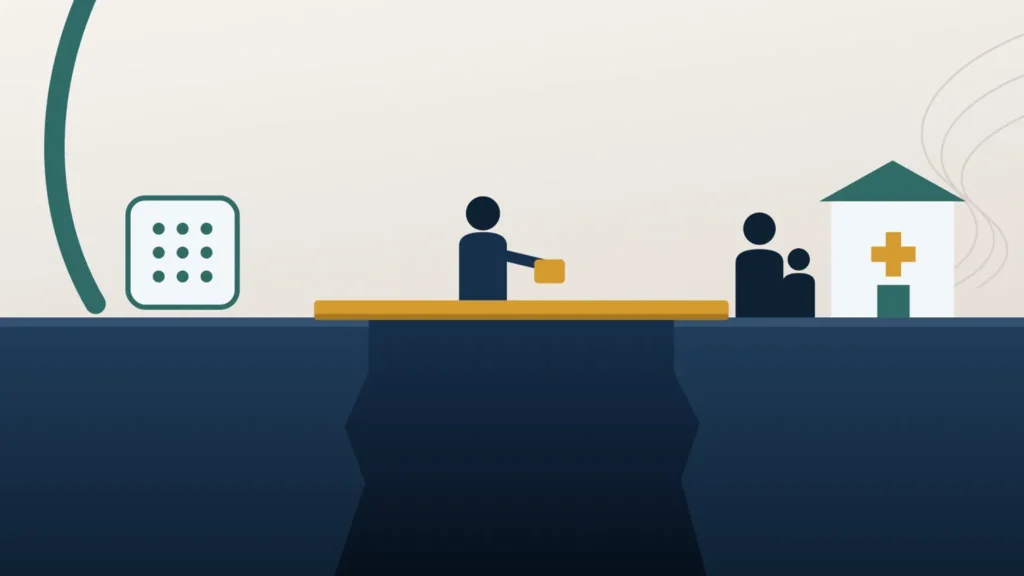
Microarray patches work. Clinical trials have shown that vaccines delivered through dissolving microneedles can match a needle and syringe. Developers are scaling manufacturing. The science is moving.
A different question remains open, and it is the one that decides whether any of this reaches a child in Adamawa.
Can a health worker who has given injections for fifteen years apply a patch correctly on a restless nine-month-old, at an outreach post, at the end of a long session, without supervision?
That is not a question a Phase 1 trial answers, or one a manufacturer can answer from a factory. It is an implementation question, and answering it means working inside the immunization system as it actually runs.
What we do
LunaVax works alongside vaccine developers to test how their platforms perform in Nigerian immunization settings. We don’t develop patches. We generate the evidence that determines whether one can be delivered at scale, and we build the systems that confirm it was.
Readiness. Our MAP Implementation Readiness Framework assesses whether a facility is prepared to deliver a new platform across five domains, identifying gaps before rollout rather than after. The Discussion Brief is published openly.
Evidence. We design and conduct implementation research, from protocol development and regulatory coordination to site engagement and study conduct. Our current study examines measles-rubella patch delivery compared with standard vaccination across four Nigerian states. The study design was developed through the Harvard Medical School Global Clinical Scholars Research Training Program.
Verification. Where records are paper-based, a dose given isn’t a dose documented. We integrate biometric verification into immunization workflows so every dose can be matched to the child who received it.
Why now
Every new delivery platform reaching low-income settings hits the same bottleneck: the technology clears clinical hurdles, then stalls between approval and routine use because nobody built the operational evidence ministries and funders need.
Patches are approaching that bottleneck now. The evidence can be built in parallel with the science, or afterwards, at the cost of years.
#BeLunacious