
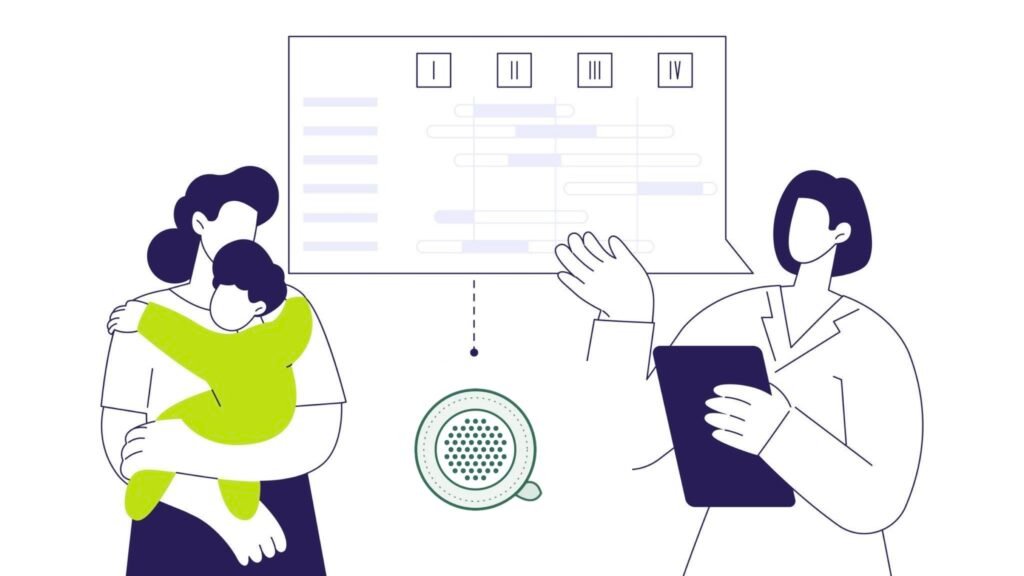
Early clinical trials of dissolving microneedle patches have produced encouraging results, and developers are advancing these technologies toward broader use. But a different question will help determine whether a patch can work in routine immunization in Adamawa, a state in northeastern Nigeria where reaching children beyond fixed health facilities remains an important challenge.
Can a health worker reliably apply a vaccine patch to a restless nine-month-old during an outreach immunization session?
That is not something an early-phase trial is designed to answer. It requires understanding how the patch would work within the immunization system as it operates in practice.
BEYOND THE CLINICAL TRIAL
Outside the controlled setting of a clinical trial, a measles-rubella microarray patch (MR-MAP) must work within a health system shaped by staffing, patient volumes, storage capacity, record-keeping, and the realities of delivering vaccines in hard-to-reach communities. Bringing patches into routine care raises a different set of questions:
- Administration. Can health workers apply patches correctly and consistently during busy immunization sessions and ensure they remain in place for the required wear time?
- Delivery. Could patches support outreach and community-based vaccination? What training, supervision and policy changes would that require?
- Systems. How would storage, waste management and vaccination records need to adapt? Patches may reduce cold-chain demands and eliminate open-vial wastage, but would their single-dose format take up more storage space than multi-dose vials?
- Equity. Could patches help reach underserved children, or might new operational barriers leave some behind?
These questions are now central to global research priorities. A 2026 WHO-led study on MR-MAP research priorities, involving 139 stakeholders, identified key implementation research needs for these patches. For government representatives from low- and middle-income countries, the top priority was community-based delivery, drawing on lessons from community health workers and volunteers.
Yet evidence from the countries that would use patches remains limited. In a 2024 WHO study across nine countries, country-level stakeholders emphasized the need for local evidence, including feasibility studies and pilots, before introducing patches at scale. Nigeria, which has one of the world’s largest populations of zero-dose children, was not among the countries studied.
Nigeria needs its own evidence, and it has to be generated here.
OUR APPROACH
LunaVax works alongside vaccine developers to evaluate how new vaccine technologies perform in Nigerian immunization settings. Our work combines implementation research, facility readiness assessment and dose verification to help determine what it takes to bring them reliably into routine care. In Nigeria, this work is led by LunaVax Institute Nigeria.
Readiness. Our MAP Implementation Readiness Framework (MIRF) assesses facility preparedness across five domains, identifying gaps that need to be addressed before implementation.
Evidence. We design and lead implementation research, from protocol development and regulatory coordination to site engagement and study preparation. Our proposed study will compare MR-MAP delivery with standard vaccination across four Nigerian states, measuring both clinical and implementation outcomes. The study design was developed through the Harvard Medical School Global Clinical Scholars Research Training Program.
Verification. Reliable immunization records are essential for tracking vaccination accurately. We integrate biometric verification within immunization workflows to help link vaccination records to the children who receive those doses.
EARLY LESSONS FROM NIGERIA
Understanding readiness starts at the facility level. Since November 2025, we have surveyed immunization facilities across our four proposed study states and identified around 160 potential study sites. Following funding, our partner AfriVacx will assess these facilities and select the 60 study sites.
Beyond identifying potential study sites, our fieldwork has helped us understand what preparation will require. Caregivers encountered difficulties with English-only materials, so we translated the survey into Hausa, Igbo, and Yoruba. The survey findings also informed the development of MIRF.
These lessons highlight the need for clear instructions in local languages, supported by simple illustrations that work in routine immunization settings. Working with vaccine developers to address these needs early can help build understanding and trust before patches are introduced.
GENERATING THE EVIDENCE
Our proposed study is designed to investigate both clinical outcomes and implementation questions in Nigeria. Alongside assessing the immune response to MR-MAP compared with injectable vaccination, the study will examine implementation outcomes, including:
- Fidelity: how accurately patches are applied during routine immunization sessions
- Acceptability: how caregivers and health workers view the patch before introduction, after learning about it, and after using it
- Cost: the resources needed to deliver the patch per child
- Readiness: whether a facility’s baseline readiness predicts how well delivery goes
Once the required approvals are in place, a preparatory pilot is planned at 12 sites using non-vaccine patches to assess application procedures, workflows, and biometric verification before any vaccine is given. This will help identify operational issues early.
CLOSING THE GAP
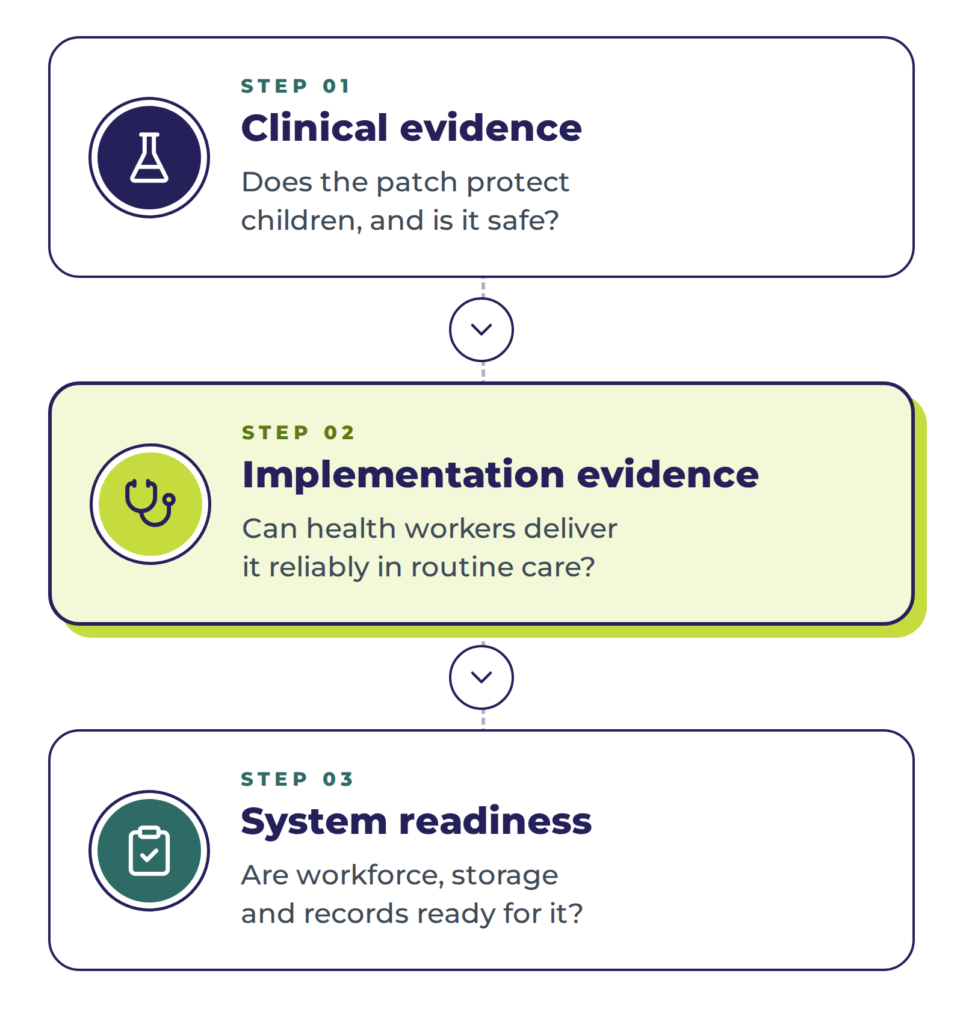
Clinical trials can show whether a vaccine produces the intended immune response. Implementation research answers a different question: what does it take to deliver it reliably where children actually receive their vaccines?
For MR-MAPs in Nigeria, that evidence remains to be generated.
Working on vaccine delivery or implementation research? Partner with LunaVax.
#BeLunacious